The Unsolved Shadow: Virginia’s Colonial Parkway Murders Endure as a Haunting Mystery
VIRGINIA, USA – For over three decades, a chilling enigma has haunted the scenic stretches of the Colonial Parkway in the eastern U.S. state of Virginia. Between 1986 and 1989, a series of brutal, seemingly interconnected crimes, now famously known as the Colonial Parkway Murders, claimed the lives of eight young individuals, with some theories suggesting the tally could be higher. This perplexing sequence of disappearances and murders left a community gripped by fear, challenged law enforcement to its limits, and etched an indelible mark on the landscape of American cold cases, continuing to baffle investigators and agonize the victims’ families to this day.

The Colonial Parkway itself, a picturesque 23-mile drive connecting the historic towns of Jamestown, Williamsburg, and Yorktown, is a gateway to America’s colonial past. Lined with dense foliage, offering serene views of the James and York Rivers, and dotted with secluded pull-offs, it was long a favored spot for tourists, history enthusiasts, and young couples seeking privacy. It was this very isolation and romantic appeal that, tragically, transformed it into a hunting ground for a predator, or predators, leaving behind a legacy of fear and unanswered questions.
A Pattern of Terror Emerges
The chilling series of events began in the autumn of 1986.
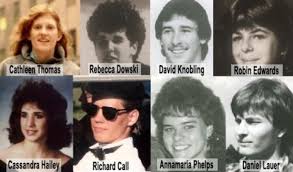
Case 1: Daniel Lauer and Laura Winans (September 1986) On September 20, 1986, 21-year-old Daniel Lauer and 20-year-old Laura Winans, both from Culpeper, Virginia, vanished after visiting the historic Jamestown settlement. Their car, a rusted 1972 Chevrolet Nova, was found abandoned along the Parkway near the Powhatan Creek rest stop, its doors locked, but no sign of a struggle. It wasn’t until October 1987, more than a year later, that their remains were discovered by hunters in a remote, heavily wooded area near the Parkway, roughly four miles from where their car had been found. While the cause of death was never definitively determined due to the advanced state of decomposition, investigators suspected foul play, possibly strangulation or stabbing. This incident set a disturbing precedent, laying the groundwork for the terror to follow.
Case 2: Cathleen Thomas and Rebecca Dowski (October 1987) Just weeks after Lauer and Winans’ bodies were found, on October 9, 1987, the horror intensified. The bodies of 27-year-old Cathleen Thomas and 21-year-old Rebecca Dowski, students at the College of William & Mary in Williamsburg, were discovered inside Thomas’s Honda Civic hatchback at a scenic overlook on the Parkway, near the York River. Both women had been strangled, their throats cut, and their vehicle partially set on fire, apparently in an attempt to destroy evidence. The brutality and the location – directly on the Parkway – immediately elevated the urgency of the investigation and confirmed the presence of a serial threat. This incident fully ignited public fear and prompted official recognition of a serial killer operating in the area.
Case 3: Cassandra Hailey and Keith Call (April 1988) The spring of 1988 brought another agonizing disappearance. On April 10, 1988, 18-year-old Cassandra Hailey and 20-year-old Keith Call vanished after attending a party in Newport News. Call’s red Toyota Celica was found at the York River Overlook on the Colonial Parkway, the same location where Thomas and Dowski were found. Unlike the previous cases, no bodies were ever recovered, leaving their families in a perpetual state of agonizing uncertainty. The similarity in location and the pattern of young couples disappearing from their vehicles strongly linked this case to the earlier incidents.
Case 4: Heidi Newbold and David Knobling (September 1989) The final, confirmed incident in the series occurred in September 1989. On September 21, 1989, the bodies of 18-year-old Heidi Newbold and 20-year-old David Knobling were discovered in the Ragged Island Wildlife Management Area, near the James River, a short distance from the Parkway. Their truck was found abandoned at a nearby boat ramp. Both had been shot in the head. While the method of killing differed from the previous cases (strangulation/cutting), the remote location, the targeting of a young couple in a vehicle, and the proximity to the Parkway led investigators to include their murders within the serial pattern.

Challenges to an Overwhelmed Investigation
The Colonial Parkway murders presented an unprecedented challenge to law enforcement agencies across multiple jurisdictions – the National Park Service, local county police, the Virginia State Police, and eventually the Federal Bureau of Investigation (FBI).
- Jurisdictional Complexity: The cases spanned different counties and federal parkland, leading to initial coordination difficulties. Each agency had its own protocols, and while task forces were eventually formed, the early stages likely suffered from a lack of a unified command structure.
- Limited Forensic Technology: The late 1980s predated the widespread use and sophistication of DNA profiling. Fingerprinting, ballistics, and trace evidence were the primary forensic tools, but often proved insufficient without strong leads. In the Thomas/Dowski case, attempts to set the car on fire further hindered forensic collection.
- Lack of Clear Modus Operandi: While a pattern of targeting young couples in isolated areas was clear, the variations in cause of death (strangulation, cutting, shooting) and evidence handling (bodies left in car, bodies removed, bodies never found) complicated the creation of a definitive single-killer profile. This led to theories ranging from a single, evolving perpetrator to multiple killers, or even a copycat element.
- Societal Biases: In some early instances, the “lovers’ lane” aspect of the disappearances may have initially led to assumptions that the victims had run away or were involved in illicit activities, potentially delaying the full recognition of the serial nature of the crimes.
- Absence of Witnesses: The secluded nature of the Parkway means there were rarely any witnesses to the abductions or murders, leaving investigators with scant direct evidence.
Expert Analysis: A Predator’s Playground and Elusive Motives
Investigators and criminal profilers have spent decades dissecting these cases. The pattern suggests a perpetrator, or perpetrators, intimately familiar with the Parkway and its secluded spots. The method of attack often implies a degree of control and a desire to incapacitate victims swiftly. The targeting of couples might suggest a power dynamic, a sexual element, or a desire to prevent witnesses.
One prevailing theory suggests a single, highly cunning individual, whose methods evolved over time, perhaps learning from each crime and adapting to avoid detection. The geographical proximity of the crime scenes, despite the varying means of death, argues for a singular actor. However, the distinct differences in methods (strangulation vs. gunshots) have also led to speculation about distinct killers, or perhaps an accomplice. The “at least ten people” in the prompt’s initial description could refer to other unsolved “lover’s lane” murders in the region during that period, which some enthusiasts and independent investigators attempt to link to the core Parkway cases, though law enforcement generally focuses on the eight confirmed Parkway victims.
The psychological profile of such a killer would likely include traits of psychopathy, a lack of empathy, and a strong need for control. The choice of locations – isolated but accessible – indicates careful planning. The lack of an obvious motive (robbery was not consistently a factor) points towards more complex, possibly psychological, drivers such as sexual sadism, power fantasies, or a pathological need to inflict suffering.
The Enduring Legacy: Grief, Advocacy, and Renewed Hope
Beyond the investigative complexities, the Colonial Parkway murders left an indelible scar on the families of the victims and the broader community. Decades of unanswered questions have fueled immense grief and frustration. The families, many of whom have become powerful advocates, have tirelessly campaigned for continued investigation, leveraging public interest and social media to keep the cases in the spotlight.
In recent years, advancements in forensic science, particularly in DNA technology and genetic genealogy, have offered renewed hope. These breakthroughs have allowed cold case units to revisit old evidence, sometimes extracting DNA from samples previously considered too degraded or small. Law enforcement agencies, including the FBI’s Behavioral Analysis Unit, continue to review the evidence, applying modern profiling techniques and forensic tools. The cases are frequently discussed in true crime documentaries, podcasts, and online forums, generating public interest and occasionally new tips, though none have led to a definitive breakthrough.
The Colonial Parkway, once a symbol of serene American history, remains a haunting reminder of the four years when terror stalked its winding roads. The shadows of Daniel, Laura, Cathleen, Rebecca, Cassandra, Keith, Heidi, and David loom large, their stories a poignant testament to the enduring mystery and the unwavering hope that, one day, the truth will emerge from the depths of the past, bringing long-awaited closure to their families and the historic Virginia landscape they once traversed.